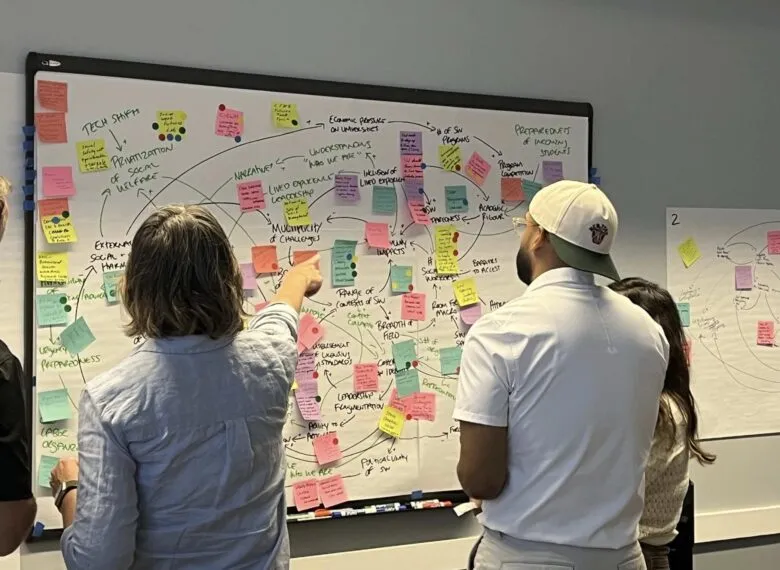
How can systems thinking help social work navigate some of its most pressing challenges? Dr. Tami Gouveia, director of the Center for Innovation in Social Work and Health (CISWH) at Boston University School of Social Work (BUSSW), recently shared one approach at the 44th International System Dynamics Conference, where she presented the first version of the Beyond Defense Causal Loop Diagram (CLD).
The diagram emerged from the “Beyond Defense: Transforming Social Work During Dangerous Times Summit” that brought together 22 social work leaders from across the United States to examine the complex, interconnected forces shaping the future of the social work profession. Facilitated by Ellis Ballard, founding partner at Tributary Design and assistant professor of practice at Washington University in St. Louis, and Kelsey Toney, partner at Tributary Design, the workshop used group model building to map how challenges across education, policy, workforce development, professional identity, and community needs interact over time.
Four Interconnected Themes Influence Social Work Practice
The resulting CLD is organized around four interconnected themes: social challenges, professional identity, policy change, and higher education and the workforce pipeline. Rather than examining these issues in isolation, the model highlights the reinforcing feedback loops that influence the profession’s ability to respond to evolving community needs.
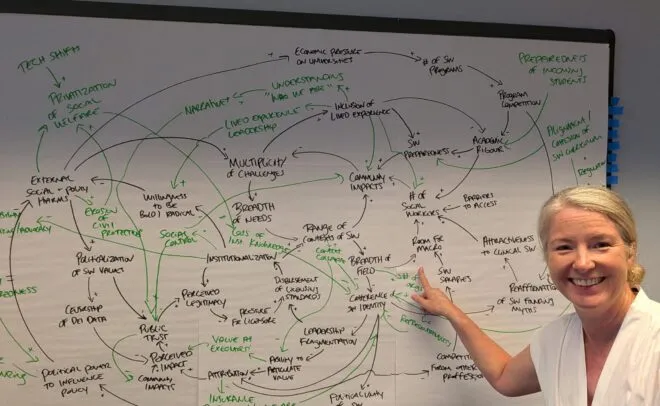
“Being able to discern the interplay between these themes is why I believe in the power of causal loop diagrams and participatory system dynamics,” said Dr. Gouveia. “I wanted to bring this work to a group of social work ‘owls’ who hold a systems-level view and can spot the challenges and opportunities we so often overlook.”
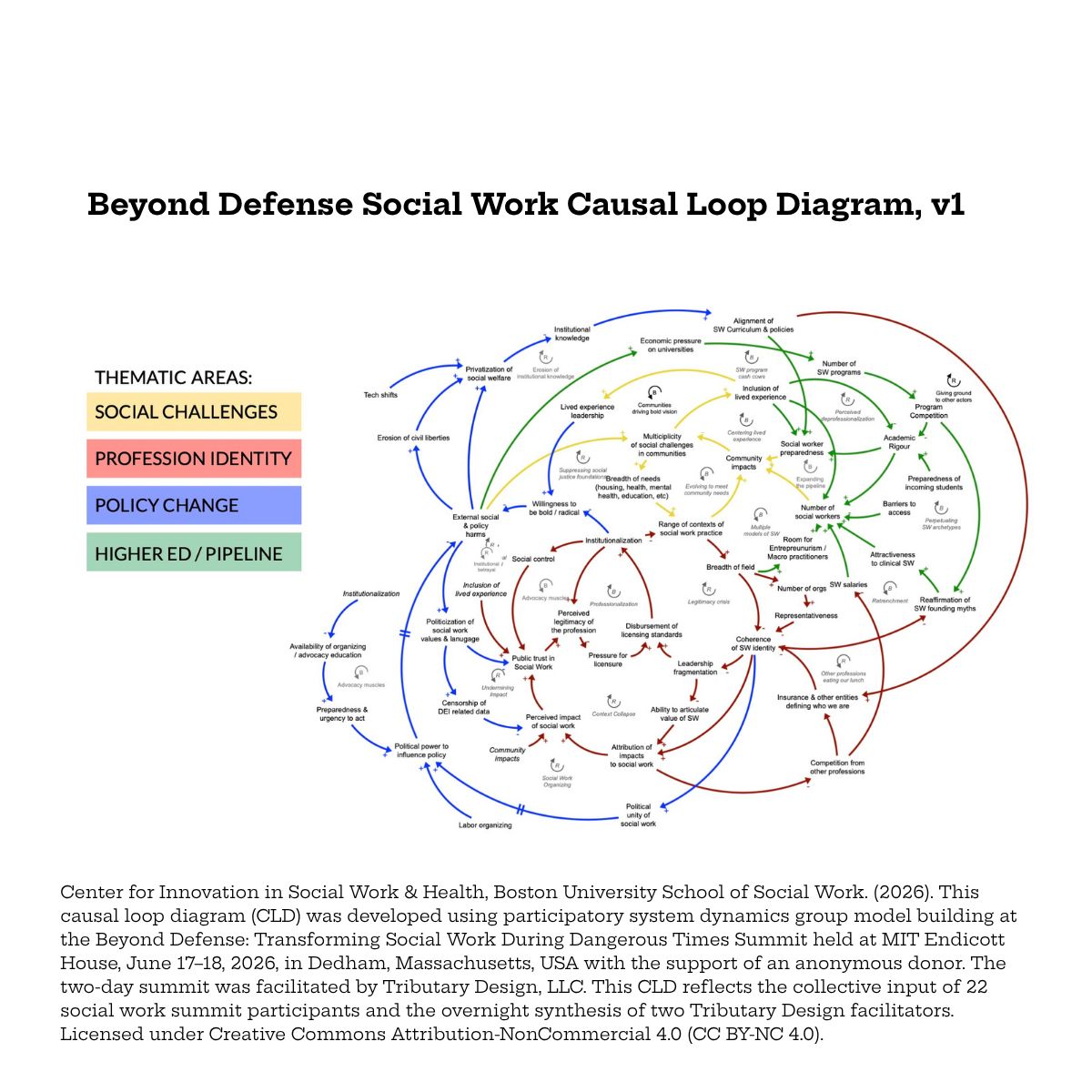
Model Highlights Challenges for the Profession
One example highlighted in the model explores how efforts to strengthen social work’s legitimacy can unintentionally reinforce a shift toward institutional and clinical practice. While this may build trust and recognition, it can also narrow the profession’s scope, limiting its ability to address the broad range of community needs that have long defined social work. The model also illustrates how rising program costs, questions about academic rigor, workforce burnout, demographic shifts, and policy pressures interact to shape who enters the profession and its capacity to meet growing demand.
The CLD is the first iteration of the “Beyond Defense” work and will continue to evolve through feedback from the social work and system dynamics communities.
Related News

Stay in the Know
Get the latest news on research, policy, and practice in social work and health right in your inbox. Subscribe to stay in the know.