Beyond Defense: Transforming Social Work During Dangerous Times
Impact
A participatory system dynamics initiative of the Social Work Innovation Lab
Beyond Defense brings social work leaders together to map the forces shaping the profession at a moment of political, economic, technological, and institutional upheaval. The goal is to move the field from reacting to threats toward shaping its own future.
Social work is being tested on many fronts. The communities social workers serve face deepening social challenges. Federal policy shifts are reshaping funding, higher education, and practice. The profession is also grappling with questions about its identity, its value, and its voice in public life. These pressures interact, and responses that address them one at a time can produce unintended consequences that are detrimental to the profession’s credibility, impact, and influence.
Beyond Defense starts from a different premise. If social workers can see how these forces connect, they can act together on the points where change will matter most.
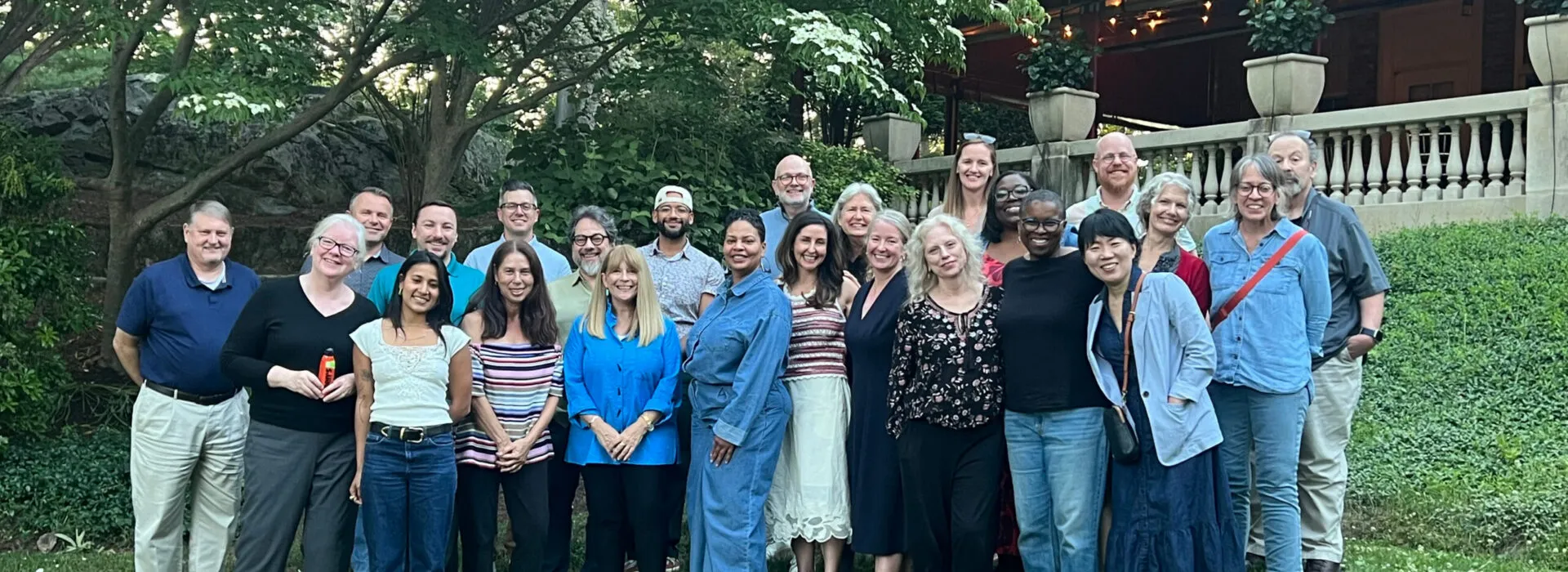
- 24 social work leaders
- 11 states
- 2 days of group model building (June 17–18, 2026)
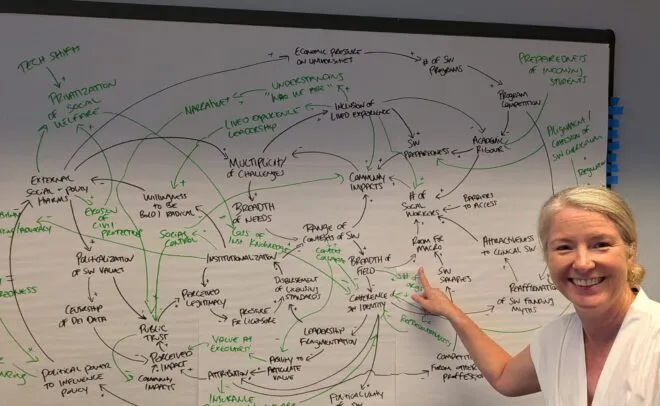
- 1 shared causal loop diagram
- 4 interconnected themes
- Clinical practice
- Community organizing
- Communications/storytelling
- Design thinking
- Entrepreneurship
- Futures thinking and foresight
- Policy making/policy advocacy
- Research and data analytics
- Leadership and management
- Systems science
- Teaching and training
- Technology and digital innovation
Participatory System Dynamics. Participatory system dynamics (PSD) is a structured way for groups to surface their collective knowledge about a complex problem. Participants identify the key variables, describe how those variables influence one another, and trace the feedback loops that keep problems stuck or help them improve.
Facilitation. The summit was designed and facilitated by Ellis Ballard and Kelsey Toney of Tributary Design, in partnership with the CISWH team.
Participants produced a causal loop diagram (CLD) that organizes the profession’s challenges into four interconnected themes:
- Social Challenges: the conditions affecting the communities social workers serve
- Professional Identity: how social work understands and represents itself, and how others see it
- Policy Change: the policy environment shaping practice, funding, and regulation
- Higher Education & Workforce Pipeline: how social workers are educated, licensed, and sustained in the field, and the policy disruptions affecting social work education and the workforce
The map shows how these themes reinforce one another, and it points to leverage points where coordinated action could shift the system.
“Beyond Defense Causal Loop Diagram © 2026 CISWH and summit participants. All rights reserved.
The summit was a starting point. In the next phase, we will map the profession’s leadership and identity challenges in greater depth and add empirical data to the map’s feedback loops where possible. We are also bringing the map to social workers who were not in the room, through presentations and hands-on workshops, so they can test, refine, and build on it.
Tributary Design
Beyond Defense was funded by the Center for Innovation in Social Work & Health.
Team: Tami Gouveia, Betty Ruth
Get Involved
Want to bring the Beyond Defense map to your organization, chapter, or classroom?